
TCF Primary Schools Are Changing
We’re introducing play, stories, and reflection to help our kids build 21st-century skills.
Why TCF is Re-Imagining Education
In a traditional Pakistani school, teachers read textbooks to students. Students recite after their teachers until they memorise their books. Teachers call on students to recite passages and, on tests, they replicate long passages by memory.
TCF has worked hard to build a curriculum and train teachers who can help children understand the concepts in their textbooks, while developing creativity and critical thinking skills. The organisation has also recognised the need to develop additional skills that are sometimes more important than academic content. These include social skills, collaboration, self-regulation of emotions and behaviours, prioritising one’s well-being and many others – all of which are critical to succeed in an uncertain environment and cannot be taught through textbooks.
In a rapidly changing world, the demands of individuals entering society and the workforce have dramatically shifted from what they were a few years ago. It is estimated that 65% of children entering kindergarten today will end up in jobs that don’t even exist right now!
How do we prepare our children for a future we cannot even imagine yet?
In 2017, TCF hired a team to re-imagine the curriculum of one of its schools in Karachi with an aim to strengthen 21st-century skills in the early years. The team was led by graduates of the Vanderbilt and Harvard schools of education.
The team did three big things: they moved towards an activity-based learning model, introduced learning through play, and developed 150 joyful Urdu storybooks.
Research shows that the early years are when children can build cognitive and socio-emotional skills that set the stage for later success. Unlike a traditional Pakistani school, TCF’s new model for education enables children to develop strong language and communication skills as well as an ability to think independently.
The model is designed to be low-cost, contextualised to a low-income area, and scalable across a variety of settings. It is a model for what early years education can look like in Pakistan.
What to Expect When You Visit TCF Next
Floor Seating for Little Learners
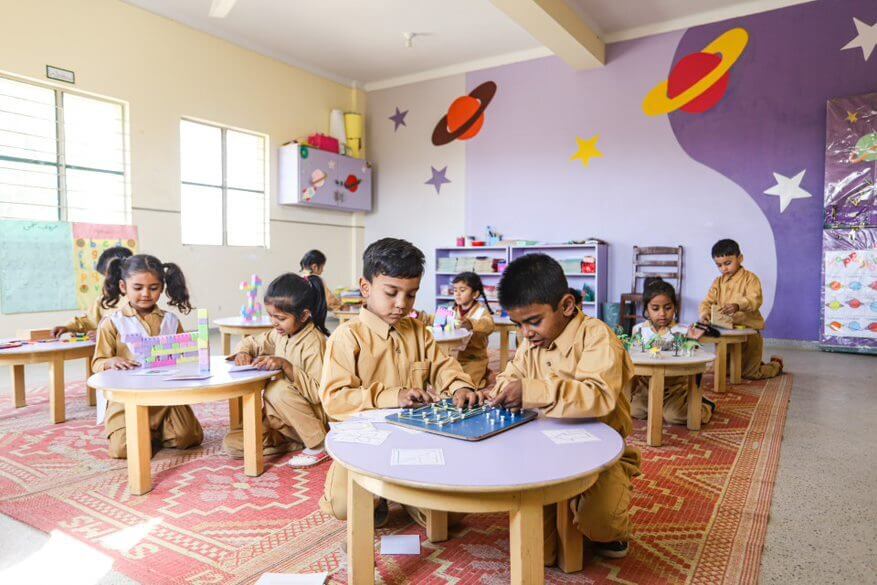
When you visit a TCF primary school, you will see children seated comfortably on floor mats. Most of us have the mistaken impression that children learn best when sitting still, but research shows that many children need extensive mobility while learning. These children learn significantly more if they move from one area to another as they acquire new information.
Floor seating allows for more space, flexibility and open environment for exploration and comfort. It also gives them independence to move around their tables as per their requirements. It is also relevant to the cultural context that our children belong to.
Colourful Classrooms with Child-Level Resources
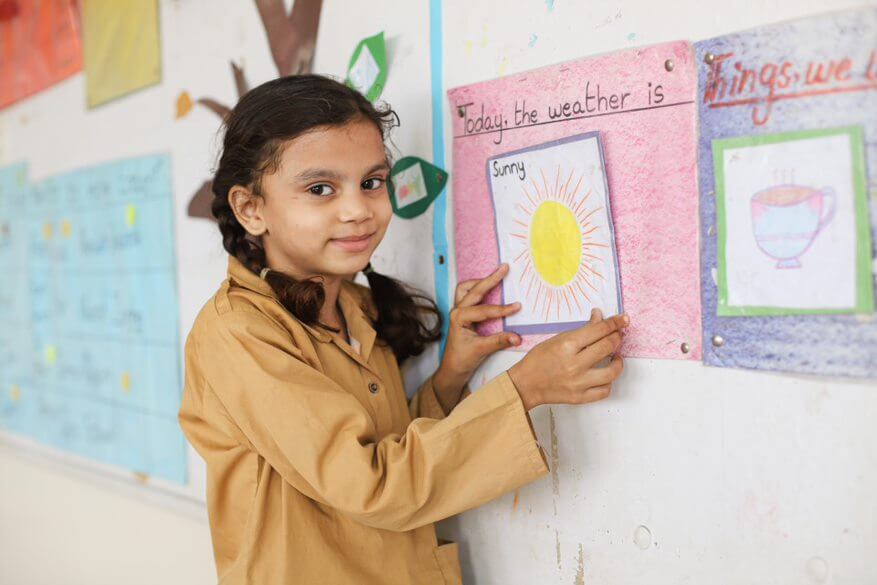
TCF classrooms are vibrantly coloured and equipped with child-level displays, creativity and bulletin boards, and word walls.
These caring, child-centred physical spaces have been created to enhance learning and encourage children to lead and regulate themselves.
Learning Through Play
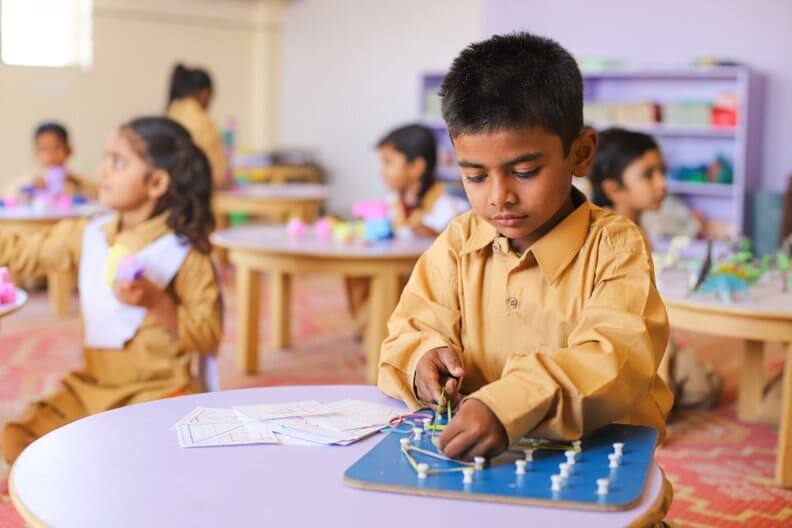
TCF has implemented play-based learning to create powerful learning opportunities across all developmental domains, including motor, cognitive, social, and emotional skills. Children now have a “choice time,” where they choose to play with the things they like. Various types of toys and activities are available for them to pick, and teachers enrich and facilitate their play.
Giving children this freedom of choice and autonomy promotes critical thinking as well as the development of social, imaginative, and self-regulation skills.
Through guided play and construction actions, TCF is also exploring theme-based activities around concepts in science and social studies. This enables students to explore these subjects in a fun and meaningful way. Students learn better as they attach ideas and skills to specific contexts, as it helps them retain information.
Read Aloud Story Time
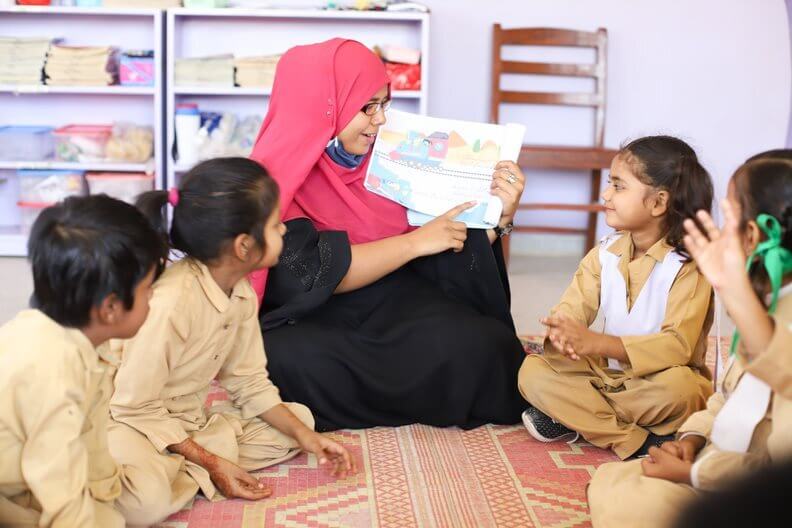
Story time embeds reading as an important daily practice. Exposure to storybooks at an early age inculcates creativity and critical thinking by exposing children to the wider world, challenging norms, and encouraging them to exercise their imagination.
The TCF team has developed nearly 150 joyful, meaningful, and context-appropriate Urdu storybooks for children to discover the joy of reading from an early age. The books challenge social norms around gender, class, and tolerance for diversity. The content is written in languages children understand (not English), encouraging self-esteem, parental involvement, and respect for culture. These stories bring experiences alive, create a sense of wonder and help sequence events. They also provide information, widen vocabulary, and make important links between the spoken and written word.
Wellness Time
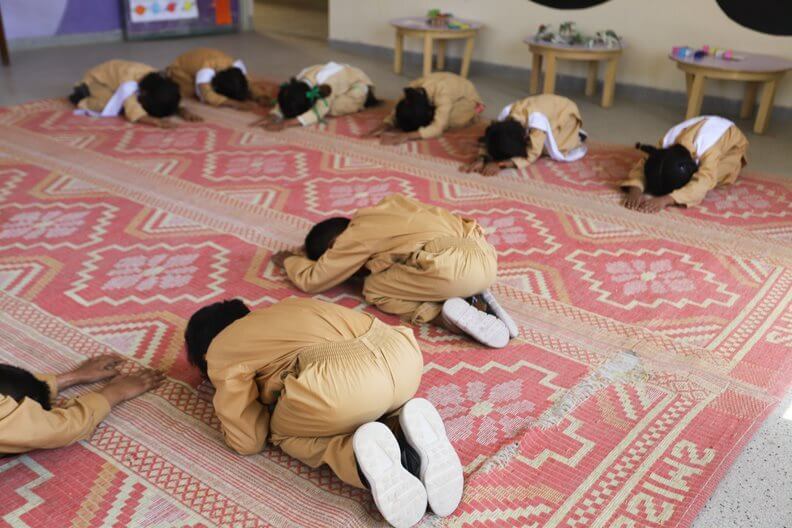
Student wellbeing and mindfulness are important parts of the programme that will be scaled across TCF primary schools in the next academic year. Through various activities, TCF ensures that students’ physical, mental, and emotional health is taken care of.
Every day, they engage in physical and breathing exercises together and are encouraged to think positively so they understand the importance of caring for their bodies, minds, and souls.
Snack Time Fun
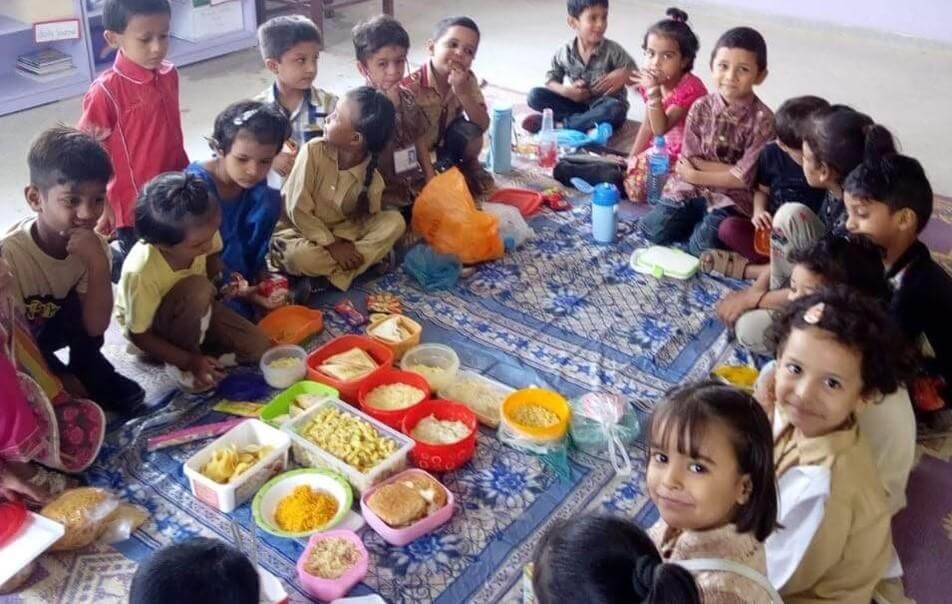
During snack time, students sit around the mat together and share their meals. This allows them to interact with each other and learn about the importance of healthy eating and hygiene. They are responsible for clearing up at the end.
As this programme scales, the design lab team continues to create, implement, and refine content and practices. While we don’t know what the future will look like, if we can develop children into well-rounded, motivated, and capable individuals with the skills, knowledge, and expertise to succeed in today’s world, then we can prepare them for the future – however uncertain it may be.
Frequently Asked Questions
Why did TCF revamp its Early Years Education Programme?
It is estimated that 65% of the children entering kindergarten today will ultimately end up in new jobs that don’t even exist today. As educators, how do we prepare the children for a future we can’t even imagine yet?
TCF felt that the answer lies in building the critical skills that will allow children to learn and thrive, no matter what the future holds—creativity, confidence, critical thinking, cognitive skills, a sense of community, and the ability to be mindful and resilient.
The early years are crucial for developing these skills. Millions of neural connections are formed every minute, and differences in language development can be seen as early as 18 months, depending on the child’s immediate environment.
So, in 2017, TCF put together a team of bright, young, and passionate educators and gave them a brand-new school to reimagine—using it as a lab to nurture these multiple intelligences in their youngest students.
Where has the Programme been scaled?
TCF’s Early Years Education Programme is currently implemented across all flagship schools, with the exception of Government Partnership Schools in the North Region. Following its system-wide rollout in 2022, the programme was expanded to include a Fitness Time component.
Who funded the educational research and classroom resources for children?
The research and scaling of this programme in Sindh have been funded by the Foreign Commonwealth & Development Office (FCDO). Under this grant, walls have been repainted with pastel colours, bulletin boards have been installed, and word walls have been created in primary school classrooms from Nursery through Grade 2. Educational toys, developmental games and activities, and other learning tools have also been procured under this grant.
Why is sitting on the floor level important?
Research proves that floor seating is more pedagogically appropriate. Students can sit comfortably and vary their position according to individual needs, which benefits their learning: “when students aren’t trying to hold themselves still in their chairs, they can integrate auditory, visual, and tactile systems of the body.” Proximity of teacher to student is much closer and more equitable, creating a better social-emotional environment that allows more opportunities for positive touch and building trusting relationships.
What happened to the old furniture that was in the primary school classrooms?
Old furniture from TCF primary school classrooms in Sindh has been moved to replace ageing furniture in other parts of the country. TCF understands that its school furniture and other resources are procured through charitable contributions from donors. Every effort is made to ensure that no asset is wasted before it reaches its supposed end-of-life.